
Departmental Highlights from the 28th EASAR Conference in Vienna (8–11 May 2025)

27 May 2025

We are delighted to share that two academic staff members and a PhD student from our department recently presented their research at the 28th Conference of the European Association of Substance Abuse Research (EASAR), held in Vienna, Austria, from 8–11 May 2025. Their contributions reflected the department’s ongoing commitment to advancing understanding in areas related to behavioural addictions, digital consumption, and public health.

Image of Departmental Highlights from the 28th EASAR Conference in Vienna (8–11 May 2025)
Dr Shu M. Yu

Interventions for safer online gambling in Europe: what is out there and what is effective?
Dr Yu presented findings from a systematic review investigating interventions designed to promote safer gambling behaviours in online environments across Europe. With the rapid expansion of the online gambling market, concerns over related harms have increased significantly. The review focused specifically on randomised controlled trials (RCTs), evaluating a range of intervention strategies such as personalised behavioural feedback, mandatory breaks initiated by operators, and self-exclusion tools. Notably, cognitive-behavioural therapy delivered via digital platforms emerged as particularly promising, especially when personalised to user behaviour. Dr Yu emphasised that while these approaches show potential, the current evidence base remains limited. More rigorous RCTs are urgently needed to validate and refine these interventions, particularly for specific at-risk user groups. The presentation concluded with a call for greater attention to early prevention strategies that account for the unique characteristics of online gambling platforms.
Image of Cristina
Dr Cristina Villalba-García

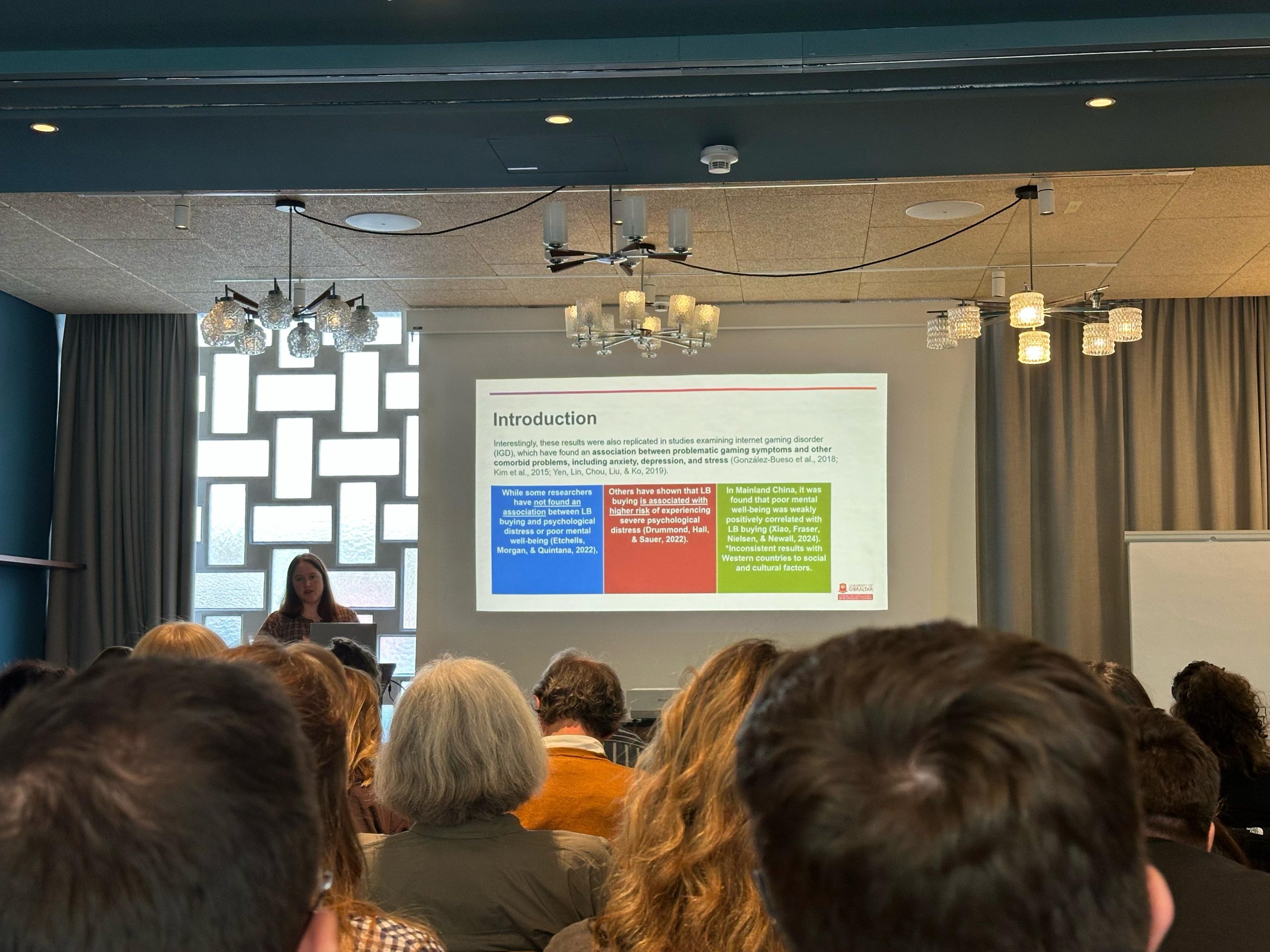
The relationship between loot box buying, gambling, internet gaming, and mental health: Investigating the moderating effect of impulsivity, depression, anxiety, and stress
Dr Villalba-García explored the psychological and behavioural implications of loot box purchasing—a practice that blurs the lines between gaming and gambling. Using cross-sectional data collected via an anonymous online survey, her study examined associations between loot box (LB) buying and indicators of problematic gambling and gaming, while also assessing the moderating roles of mental health factors such as impulsivity, depression, anxiety, and stress. Findings revealed strong correlations between risky LB purchasing and elevated levels of psychological distress. Further moderation analyses demonstrated that impulsivity and anxiety significantly amplified the link between LB buying and gambling symptoms, whereas depression appeared to have a more nuanced effect, strengthening associations with internet gaming in some contexts and weakening them in others. These insights suggest that loot box purchasing may share underlying risk factors with behavioural addictions and highlight the need for policy discussions around regulation and consumer protection in digital gaming environments.
Image of Luca
Luca Degiorgi, PhD Student
Dark patterns in video games: A systematic literature review
PhD candidate Luca Degiorgi presented his ongoing work on a systematic review of “dark patterns” in video game design—practices that intentionally manipulate user behaviour for commercial gain. These include techniques such as predatory monetisation, time-gating, forced continuity, and deceptive interface design, all of which are becoming increasingly prevalent in the digital games industry. Despite the growing use of the term “dark patterns”, existing academic literature remains fragmented, with varying definitions and typologies used across studies. Luca’s review applies the PRISMA framework to examine peer-reviewed publications indexed in Scopus, Web of Science, and PsycInfo, with the aim of consolidating knowledge and proposing a clearer classification of dark pattern strategies specific to gaming. His preliminary findings suggest a need for greater standardisation in how dark patterns are conceptualised and studied, as well as stronger ethical frameworks to guide future research and industry practice. Full results will be shared upon completion of the review.
We extend our congratulations to Dr Yu, Dr Villalba-García, and Luca Degiorgi for their impactful contributions and for representing the department at such a distinguished international forum. Their research highlights critical intersections between technology, behaviour, and mental health, and we are proud to support their work on the cutting edge of addiction and digital wellbeing research.
Find out more about the Centre of Excellence in Responsible Gaming here