
A New Home for Ideas: the Kusuma Trust Conference Suite
16 October 2026 | NEWS
11 March 2026
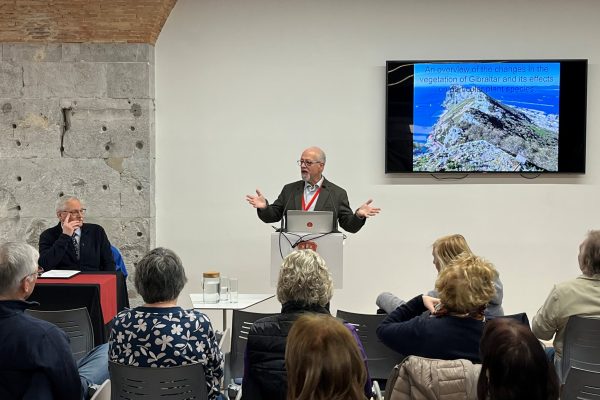
Our University’s Community Lecture Series began this year on 6ᵗʰ March with an engaging and thought-provoking lecture titled ‘An Overview of the Changes in the Vegetation of Gibraltar and Its Effects on Particular Plant Species’, delivered by Leslie Linares, a retired physics teacher, award-winning Gibraltarian photographer, and local botanist who has documented the Rock’s vegetation for over five decades.
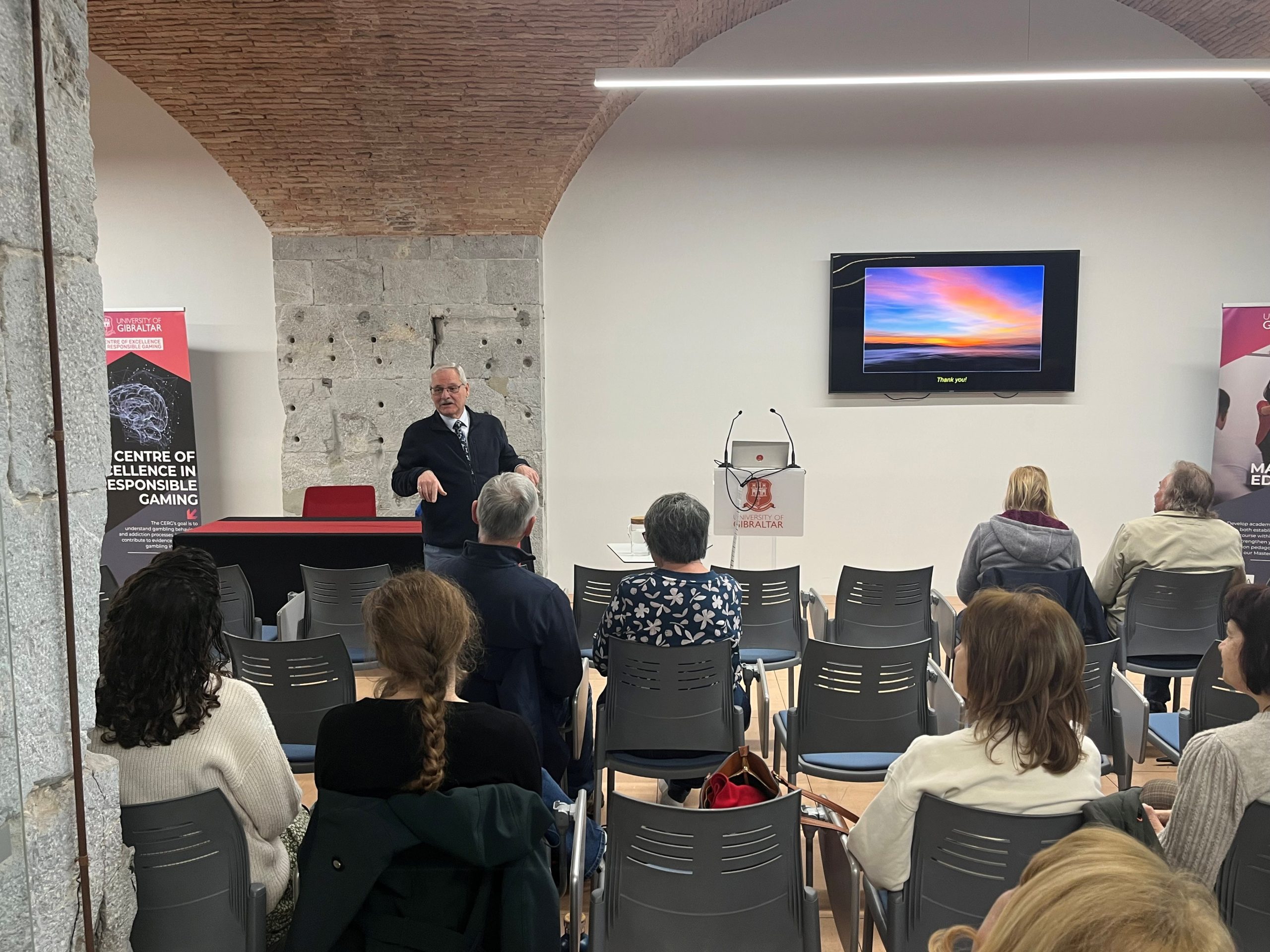
The lecture explored how the vegetation of Gibraltar has evolved since the nineteenth century, highlighting the many ways in which human activity has shaped the Rock’s natural habitats. While some changes have had positive outcomes, others have had detrimental effects, particularly through the introduction of invasive species that can outcompete native flora and, in some cases, contribute to local extinction.
Drawing on more than half a century of photographic documentation, Leslie presented a remarkable visual record of Gibraltar’s changing landscape. Almost all of the photographs shown during the lecture were taken by Leslie himself, with the earliest image in the presentation dating back to 1966, offering a unique long-term perspective on the ecological transformation of the Rock.
The talk examined a range of vegetation types and their habitats, including maquis vegetation along Inglis Way, garigue habitats above Martin’s Path, and chasmophytic (cliff) vegetation that grows in rock crevices. Leslie highlighted how these environments support distinctive plant communities, including species such as the Gibraltar Chickweed (Cerastium gibraltaricum), which can survive in challenging cliffside conditions.
Historical comparisons formed a central part of the lecture. Leslie contrasted photographs from different decades to illustrate dramatic ecological change, for example, images of the lower slopes of the Rock in 1982, when vegetation was sparse, compared with today’s landscape where dense shrub communities are regenerating.
The lecture also explored the effects of land management practices and infrastructure changes. Leslie showed how vegetation has progressively recovered in areas such as the East Side sand slopes, where a presented photograph from 1999 already showed signs of natural vegetation regeneration following the removal of some water catchment sheets, as well as around Bruce’s Farm, where clearing and firebreak management have influenced plant succession.
Alongside the wide range of flowers and plant species illustrated through his extensive photographic collection, Leslie also discussed several rare or declining species, including Helianthemum marifolium subsp. origanifolium (Yellow Rockrose), Allium pallens (Pale Garlic), and the Gibraltar Campion (Silene tomentosa), whose last record in the wild dates to 2008.
Leslie also noted several species that have not been observed in recent years, such as Filago gallica (Narrow-leaved Cudweed), which has not been recorded locally for approximately 15 years, raising important questions about their current conservation status.
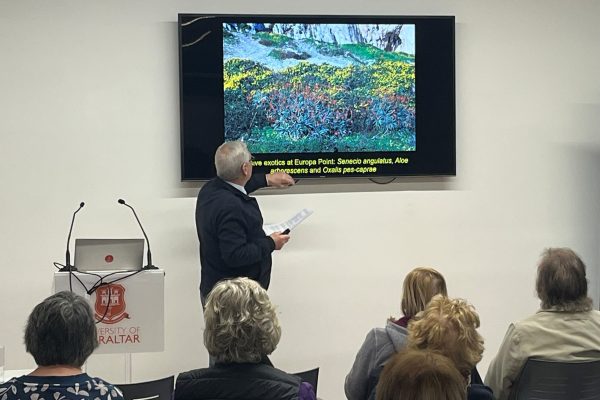
In addition, Leslie highlighted the growing impact of invasive plants, such as the Bermuda buttercup (Oxalis pes-caprae), which spreads rapidly and suppresses native species. Other invasive exotics discussed included Agave americana, various Aloe species, and others that pose challenges for conservation efforts. Leslie also discussed the impact of the cochineal insect on Opuntia ficus-indica, noting that the species has been depleted in some areas.
Through detailed observations and decades of field experience, Leslie provided a compelling overview of how Gibraltar’s vegetation has changed since the late nineteenth century, emphasising the importance of monitoring habitats and protecting native species.
The lecture offered the audience a fascinating insight into the dynamic relationship between human activity and natural ecosystems and set an excellent tone for the first event in this year’s Community Lecture Series.
16 October 2026 | NEWS

8 September 2026 | NEWS

11 August 2026 | NEWS

© Copyright 2026 University of Gibraltar. All rights reserved. Registered charity no. 273

