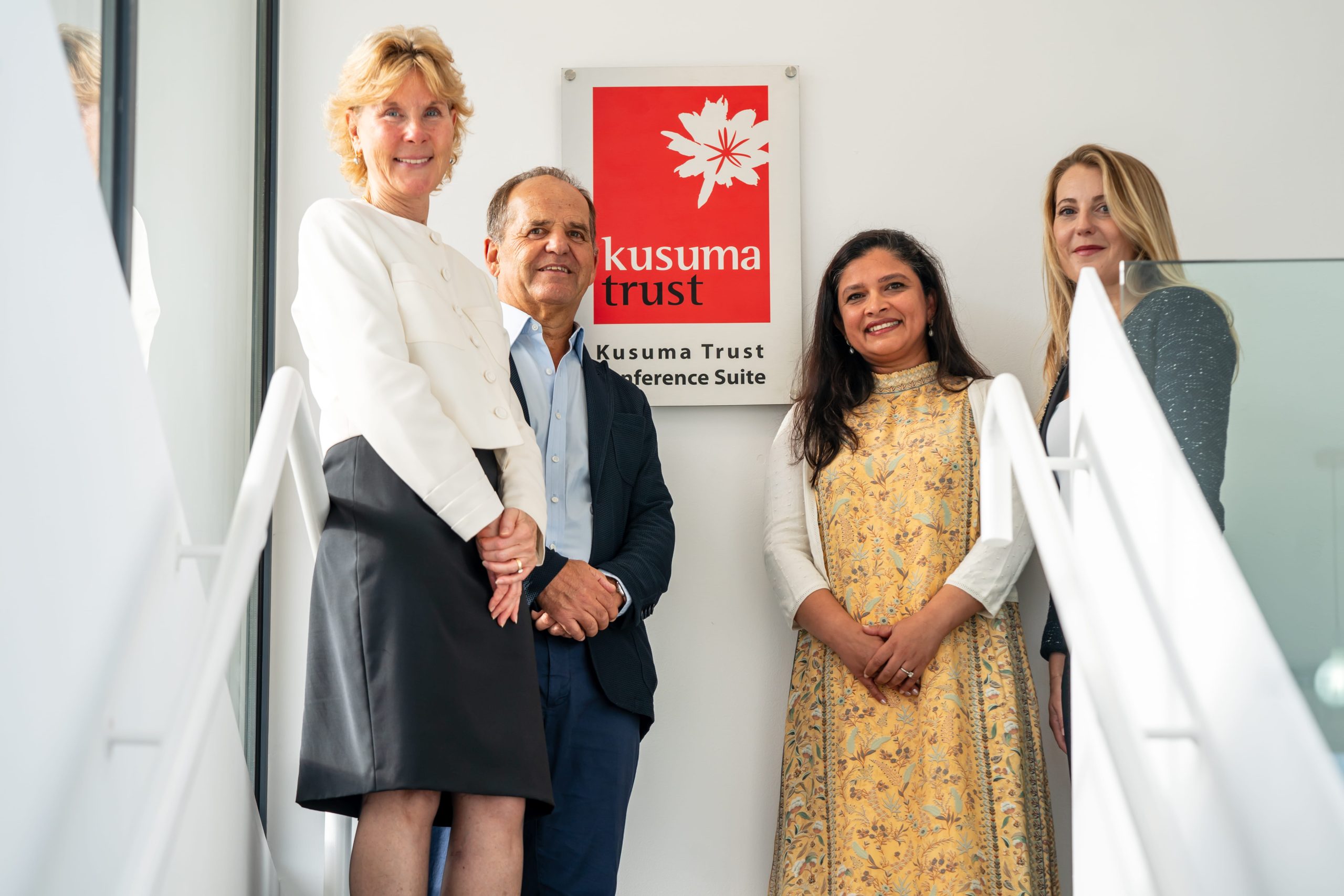
A New Home for Ideas: the Kusuma Trust Conference Suite
16 October 2026 | NEWS
20 May 2026
On 30th April, Professor Jamie Trinidad, Beacon Professor at our University, Director of Studies in Law at Wolfson College, Cambridge, and Fellow of the Lauterpacht Centre for International Law at the University of Cambridge, delivered a Beacon Professor Lecture titled ‘The Proposed Handover of the Chagos Islands: A View from the Rock’.

During the lecture, Professor Trinidad explored the legal, political and historical dimensions of the proposed handover of the Chagos Islands, also known as the British Indian Ocean Territory, to Mauritius. He noted that the issue has generated significant discussion in Gibraltar, particularly because of its relevance to questions of sovereignty, territorial integrity, self-determination and the position of Non-Self-Governing Territories.
In opening, Professor Trinidad outlined the historical background to the dispute between Mauritius and the United Kingdom. He explained that the Chagos Archipelago was unlawfully separated from the then British colony of Mauritius in 1965, ahead of Mauritian independence in 1968, to make way for a joint UK/US military base on Diego Garcia, the main island in the archipelago.
The lecture also shed light on the mistreatment of the Chagossian people. Shortly after the separation of the islands from Mauritius, the Chagossian population was covertly expelled by the British colonial authorities. Professor Trinidad highlighted the human consequences of this history, noting that most Chagossians now live in the United Kingdom, Mauritius and the Seychelles, and that their attempts to return to the islands have been repeatedly blocked by the UK.
Professor Trinidad then considered the legal challenges brought by the Chagossians in response to their expulsion. Although attempts to challenge their removal before the UK courts were unsuccessful, the International Court of Justice issued an Advisory Opinion in 2019 which held that the UK had acted unlawfully when it separated the islands from Mauritius and should withdraw from the territory as soon as possible. This position was subsequently endorsed by the UN General Assembly and by the International Tribunal for the Law of the Sea.
The lecture also addressed the more recent political developments that followed these legal findings. Under significant international pressure, the Conservative Government in the UK began negotiations for the handover of the Chagos Archipelago to Mauritius, alongside a proposed 99-year lease-back of Diego Garcia to the UK to secure the continued operation of the military base. An agreement was signed in May 2025, although Professor Trinidad noted that the ratification process was later paused after the US President withdrew support for the deal.
Particular attention was given to the relevance of the Chagos case for Gibraltar. Professor Trinidad observed that the case may be helpful in some respects, particularly because the International Court of Justice recognised that the right to self-determination of the peoples of Non-Self-Governing Territories (line Gibraltar today, and Mauritious before 1968 independence) includes a right to respect for their territorial integrity. He suggested that this finding strengthens Gibraltar’s international position, given Gibraltar’s own status as a Non-Self-Governing Territory.
At the same time, Professor Trinidad reflected on the broader implications of the proposed handover. He noted that the proposed transfer of territory to a comparatively much weaker state may also be understood as reflecting the UK’s diminishing power and influence in the world. However, he emphasised that the most concerning aspect of the case remains the treatment of the Chagossian people, whose rights and interests have been swept aside for military and political reasons.
The lecture concluded by underscoring the continuing injustice faced by the Chagossians, who, after 60 years of exile, are still not being allowed to resettle on the islands. In doing so, the lecture provided a timely and thought-provoking examination of a complex international legal and political issue, while also inviting reflection on its wider significance for Gibraltar, the principle of self-determination, and the rights of peoples in Non-Self-Governing Territories.

16 October 2026 | NEWS

8 September 2026 | NEWS

11 August 2026 | NEWS

© Copyright 2026 University of Gibraltar. All rights reserved. Registered charity no. 273

