MSc Sustainable Maritime Operations

Join MSC in Sustainable Maritime Operations, and steer the helm of change.

KEY FACTS

Lines Icon

Faculty:
School of Maritime Science

Clock Icon

Study Options:
Part Time

Calendar Icon

Start Date:
TBC

Marker Icon

Level:
Postgraduate

Hourglass Icon

Course Length:
Part-time 2 Years

Marker Icon

Qualification:
MSc

Pound Icon

Fees:

All Students: £5,625* per annum

*Fees are for the academic year 2026/27 and are subject to indexation.

Pencil Icon

Apply:
Admissions for this programme will not be open for the 2026 academic year.

About this programme

The global shipping industry, responsible for 90% of global trade, is confronted with mounting challenges to operate sustainably due to increasing environmental concerns and stringent regulations. By offering a comprehensive curriculum that blends theoretical insights with practical application, the MSc Sustainable Maritime Operations programme provides you with the expertise necessary to navigate the complexities of sustainable maritime operations in the 21st century and contribute positively to the industry’s future.

The MSc Sustainable Maritime Operations programme is specifically designed to equip both seafarers and shore-based professionals with the knowledge and skills required to navigate these complexities and to contribute effectively to the transition towards a sustainable future in shipping. Through a blend of theoretical insights and practical application, the programme prepares graduates to address the industry’s sustainability challenges and align their practices with the IMO’s sustainability agenda.

The programme curriculum provides a deep understanding of global supply chains, emphasising the critical role of shipping in enhancing resilience and efficiency within these complex networks, and equips students with innovative strategies and practices to minimise the environmental impact of shipping operations. You will also learn how to implement sustainable solutions that contribute to environmental stewardship through the exploration of alternative fuels, energy-efficient technologies, and waste reduction measures.

School of Maritime Science

Key Features

Modules

This programme consists of 180 credits at Level 7. The programme comprises six taught modules:

  • three compulsory core modules and three elective modules to suit student needs and career aspirations.
  • For the final award, students must complete a research project on a chosen subject, providing evidence of managing an investigation and demonstrating independent thinking and professional expertise.
Year 1 
Module Title         Credits    Semester        Compulsory / Elective        Face to Face / Online   
Future Fuel and Renewable Energy
in Shipping
20 1 C Face to Face, 3-Week Intensive
Delivery
Project and Data Management 20 1 C Online
Maritime Operations and Safety
Management
20 1 C Online
Maritime Spatial Planning and
the Blue Economy*
20 2 E Online
Innovation and Technology in
Multimodal Supply Chains*
20 2 E Online
Sustainable Shipping and
Marine Environment*
20 2 E Online
Maritime Law and Insurance 20 2 E Online

*Module will run subject to minimum numbers.

Year 2
Module Title         Credits    Semester        Compulsory / Elective        Face to Face / Online   
Research Methodology and
Project Proposal
15 1 C Online
Research Project 45 2 C Online

Programme mode of delivery for a typical student studying the MSc Sustainable Maritime Operations
part-time over two-years.

Successful completion of this programme will equip students with the knowledge base and skills to be
effective leaders in sustainable maritime operations, with specialisation of their choice. It is expected that the main areas for employment will be:

  • Port operations
  • Ship management business
  • Sustainable shipping analytics
  • Freight forwarding and associated maritime logistics
  • Environmental protection of waterways and the coast
  • Maritime risk and safety management
  • Decarbonisation strategy development in maritime operations
  • Renewable energy and alternative fuel implementation in shipping

Although many possible career paths are not addressed directly in the programme, the research element of the programme may follow a student’s specific interest that might be focused on a particular career.

View Full Programme Specification (Subject to Change)
Mode of delivery 
Year / Semester Modules Delivery Mode
Year 1 Semester 1 Core Modules TBC
Year 1 Semester 2 Elective Modules TBC
Year 2 Semester 1 & 2 Research Methodology and
Research project
TBC

Expert Teaching

The School of Maritime Science teaching team brings together a multi-disciplinary group of internationally-recognised specialists in their respective fields. We aim to provide world-class teaching by utilising our teaching teams extensive, real-world experience in the Maritime Industry. Our faculty consist of actively engaged professionals with hands-on involvement in industry developments, ensuring you receive the most up-to-date insights and the practical skills needed to excel in the maritime domain.

Drawing upon their extensive industry backgrounds, our lecturers infuse their lessons with practical insights, case studies, and examples, enriching the learning experience with tangible relevance. Whether it’s navigating regulatory frameworks, optimizing vessel design for efficiency and safety, or understanding the intricacies of global maritime trade, our teaching team aims to equip you with the tools and perspectives essential for success in the dynamic maritime landscape. Our approach of integrating theory with real-world application, supports greater understanding of fundamental concepts and navigation of the challenges and opportunities of the maritime industry with confidence and proficiency.

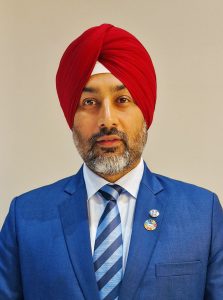
"This programme equips students with the knowledge and skills to champion sustainable maritime practices; this will be necessary for the next generation of maritime leaders who will steer the industry toward a cleaner, more efficient, and sustainable horizon."

Captain Sukhjit Singh

Image of Captain Sukhjit Singh

QAA Global Accreditation

The University is delighted to have achieved global accreditation from the Quality Assurance Agency for Higher Education (QAA), the UK’s independent quality body and a global leader in quality assurance for higher education.

“In achieving QAA’s global accreditation, the University has displayed its compatibility with international best practice.”

Vicki Stott, UK Quality Assurance Agency (QAA) Chief Executive.

WHY UNIGIB?

Entry Requirements

Typically, an applicant should meet one of the following criteria:

  • A bachelor’s degree (second-class honours or higher) in a relevant subject from a recognised institution, OR
  • An Officer in the Merchant Navy holding an STCW Management Level Certificate of Competency (COC) OR
  • An Officer in the Merchant Navy holding an STCW Operational Level Certificate of Competency (COC) with at least five years of experience at this level, OR
  • A first degree and a minimum of five (5) years of middle management experience in a maritime-related company.

AND

  • Have essential ICT skills, such as word-processing, email and use of internet.

English Language Requirements:

If English is not the student’s first language, they must have one of the following:

  • IELTS: 6.5 with 5.5 minimum in each skill.
  • Cambridge Certificate of Proficiency in English (CPE): Grade C.
  • Cambridge Certificate of Advanced English (CAE): Grade B.
  • Pearson Test of English (Academic): 60 with 51 in each component.
  • IBT TOEFL: 90 with no subtest less than 17.
Find out More

Offers are based on a combination of qualifications or predicted grades, the applicant’s personal statement and references. For guidelines on personal statements and references please click here.

Fees

Programme Fee Year
Home £11,250 Year 1&2 (total fee)

Note: the above fees are for the Academic year 2026/27 and are subject to indexation. Students will be required to pay the full fee amount within their first year of the programme. 

Apply

Admissions for this programme will not be open for the 2026 academic year. Further information on future intakes will be published in due course.

Application Checklist

Bursaries and Scholarships

The University of Gibraltar hosts or directly offers a limited number of scholarship programmes to support your studies. These scholarships are highly competitive; they are available to support undergraduate, Master’s degree and PhD programmes and are made available to students based on certain criteria.

Am I Eligible?

For applicants who have been resident in Gibraltar for more than five years you may be eligible for funding from the Department of Education. Once you receive your offer letter from the University of Gibraltar, you can apply to the Department of Education.

Enquire

Contact Us

You can also call us and speak to one of our team on +350 200 71000.

Student Accommodation

Accommodation for University of Gibraltar students is available at the purpose built Europa Suites, located just a two-minute walk from our Europa Point Campus.

Find Out More

Related Courses

Postgraduate
MEd
MEd. (Master of Education)

The Masters in Education (MEd.) programme is a generalist master’s degree which seeks to provide you with the opportunity to ext[...]

  • 2 Years
  • Placement option
  • Part Time

View Course